
–
I decided that this year I’d occasionally take a look back at my long & inglorious career as a children’s book author. Readers ask me how many books I’ve written and I honestly don’t know the answer. Lately I’ve been guessing, with my voice rising at the end, “About ninety?”
I published my first book in 1986, at age 25, a picture book titled Maxx Trax: Avalanche Rescue! Long out of print, I will still get the odd piece of fan mail about it. And since then, I’ve more or less hung in there and . . . survived. Often barely. That’s really my greatest accomplishment. That I’m still standing.
Just last week, in partnership with author Audrey Vernick, we handed in the 3rd title in our upcoming graphic novel series, Bigfoot and Dodo. We can’t wait to see it, but we’ll have to: The books won’t be out until sometime in 2027. There are other books afoot. A new lower middle-grade adventure series, The Survival Code (two titles coming, also in 2027), and a 3rd title in my “And a Moose!” series of easy readers, Two Astronauts and a Moose! Coming in, yes, I’m afraid so, 2027.
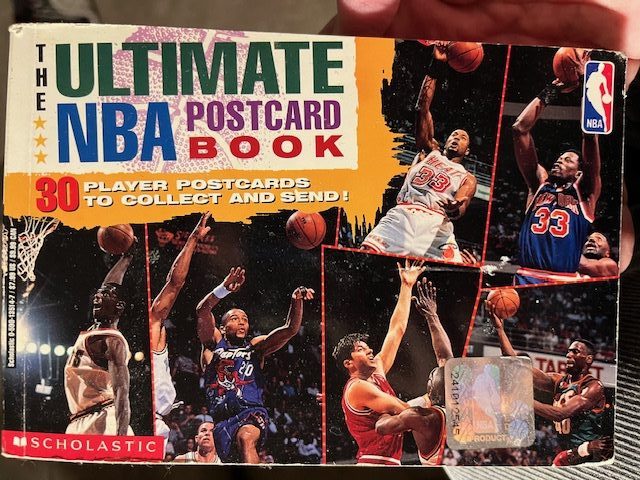
Anyway, welcome to The Ultimate NBA Postcard Book!
–

–
This book came out in 1997, copyright held by NBA Properties, Inc. I was a freelance writer, hungry for work: a hired gun. Around that time I was consulting with Alan Boyco at Scholastic Book Fairs, and doing odd jobs for Barbara Marcus with Scholastic Book Clubs, and just beginning to conjure up the “Jigsaw Jones” mystery series. This little project came, as I recall, at the request of Alan Boyco, who was very kind to me over the years.
The “book,” of course, was not quite a book. It was a collection of postcards with brief player profiles on the back. Here’s an example of a “page,” which was printed on sturdy cardboard stock:
–

–
The book consisted of 30 postcards, featuring many of the NBA’s top players at the time: Toni Kukoc, Rik Smits, Chris Webber, Joe Dumars, Patrick Ewing, etc. My writing occupied a small space on the back. Like so:
–

–
Maybe not the highest literary standard, I realize. But the truth is, I love this kind of writing. And I mean, I have always loved it: that classic “punchy” sportswriting voice. And while I worked hard in my career to avoid getting trapped in that box — pigeonholed as “just” a sports guy — it was something I very much enjoyed and still respect. And I was good at it, too.
Here’s a closer sample from the book:
–

–
I still like the opening to my write-up on Glen Rice:
What does Glen Rice mean to the Charlotte Hornets? Instant offense. Winner of the three-point contest at the 1995 NBA All-Star Game, Glen has one of the purest shots in the league. He sets up behind the art and fires hoop-seeking rainbows . . .
That’s a swish, right?
Growing up, like so many kids, I was a huge sports fan. My favorite team was the New York Mets. When I was 8 years old, the “Miracle Mets” won the 1969 World Series. I was there, it seems, for every pitch. Watching the games with my mom, an old Brookly Dodgers fan who chomped on ice and smoked Chesterfields. In the days before ESPN and social media highlights, the only way to relive the games and follow the players in depth was to open the newspaper and read. Today I consider myself blessed to have lived in that time, because my love of sports turned me into a reader. And my first favorite writer — the first writer I was aware of, and actively enjoyed — was Dick Young, who wrote for the New York Daily News.
His writing was funny, fast-paced, sharp, and stylish. On Sundays, he penned a long, free-flowing column called “Young Ideas” where he riffed on all sorts of things, often separated, I think I remember, by an ellipses.

Young, a truly larger-than-life sports writer, would later become a pariah in New York, since he wrote a series of brutal, cruel, merciless columns that helped drive Tom Seaver, the Franchise, out of New York. The world of sports and American culture had changed, and Dick Young, staunchly conservative, did not change with the times. He didn’t care for hippies or the freedoms (and wealth) of modern ballplayers. Anyway: A kid, I read his columns religiously.
It is very possible that Dick Young had the most lasting effect on my writing style than any other writer I later encountered. I’d love to say it was Joan Didion or Richard Ford, but in life, nobody quite ever measures up to your first love.
Anyway, here’s the title page and that’s me, James Preller, a guy just trying to earn a living as a writer, gratefully taking whatever job came my way.
–
